Skip to content

Kuroshio Athletics

I have walkedthe same path.

Paul WangVanderbilt Men's Tennis · NCAA Division I

Agencies submit the application. We care more about whether the player is ready before it goes out.

Long-term US college preparation for Taiwanese tennis players, from the 8th-grade course plan to the end of freshman year in the States.

From the 8th-grade course plan to the end of freshman year

Pricing formula is published. No case-by-case negotiation

No guarantee of admission, offer count or scholarship amount

Because the final decision always sits with the schools and the coaches.

The US clock runs a year ahead of Taiwan's

What grade is the player in?

The NCAA recruiting calendar is written in US grades. Taiwan's first year of senior high school (Grade 10) is the US sophomore year. Pick a grade and we will tell you three things: where the player stands, how much time is left, and what matters most right now.

Start now and you get the full three to four years.

At this stage there is no rush to pick schools. What matters is laying the foundation. This year has few pressing deadlines, which is exactly why it is the easiest one to waste.

Starting early is not about deciding on a school early. It is about giving the player more choices three or four years from now.

Months left to end of freshman year
70months
Next key date
Grade 9, Septembergrades start counting toward the NCAA core GPA, in 12 months
Academics

Plan the high-school course load early and confirm the direction of the 16 NCAA core courses.

English

Build the language early instead of cramming right before applications.

Tennis

Start a real record of training, matches and UTR growth.

Personal

Begin working on the question: who am I besides a tennis player?

Suggested plan
Sign the Recruiting Project in Grade 10; Foundation can be added from Grade 10Sign the Recruiting Project before August 15 of the summer before Grade 11 and you pay the base price. Foundation is a one-year small-group program, mainly Grade 10 and 11, independent of the Recruiting Project.

How long this road is

How long we stay,counted out first

From the 8th-grade course plan to the end of freshman year in the States. This is not a service for the application season. It is a road with a length, with stages, and with one ruler that does not change.

Duration

The base length of the Recruiting Project. From the day you sign to the end of freshman year.

Stages

From looking clearly first to the end of year one. Every stage has one question to answer.

Axes

One standard, tracked continuously. Every report can be read against the last one.

Founder

Paul walked this road himself and runs it himself. Not outsourced to a consultant.

The nine axes: tennis level, body and craft, academics and NCAA eligibility, English, resilience and asking for help, identity and direction, self-management and self-advocacy, knowing the system and landing prep, support system.

Six stages, on the Taiwanese school year

Every stage ends withone question it must answer

The American recruiting timeline starts earlier than most Taiwanese families expect. What the NCAA calls sophomore year roughly matches Taiwan's first year of senior high (Grade 10), and junior year roughly matches the second (Grade 11). By the time many families start thinking about US college in Grade 11 or 12, the critical preparation window has already opened. So we split the whole road into six stages.

Stages 1 and 2 are the preparation: getting the academics, the English, the UTR, the film and the recruiting material ready. Stages 3 to 5 are the Recruiting Project: coach outreach, choosing schools, offers, and actually landing in the US through freshman year. It is not the same work every year. It is the right work at the right time.

Stage 0Any gradeConsultation 1,500Assessment 7,500

Look before you begin

One-to-one consultation, NT$1,500. Sixty minutes on where the player is, the roads open to them, and how we work. Full assessment, NT$7,500. From Verified UTR, transcripts, match film and the family's goals, we work out where the player actually stands and which paths are viable. We do not flatter the conditions, and we do not say nice things to win the case.

  • Even if you never join, you keep a full assessment report you can act on yourself

What it has to answerIs now the right time to start? And if we start, which stage do we join at?

Stage 1Grade 8 spring to Grade 912 to 18 months

Lay the foundation

At this stage there is no hurry to approach coaches. What gets built first is the foundation recruiting will later stand on: academic eligibility, English habits, a training record, and an understanding of who they are.

  • Check the high-school timetable against NCAA core courses early
  • Open and manage the NCAA Eligibility Center account
  • Start tracking core-course GPA and academic performance
  • Build the habit of using English and keeping a training log
  • Track progress over time through one-to-ones, monthly reports, quarterly reviews, parent workshops and a mentor
  • Start on a question harder than UTR: who am I when I am not playing?
  • Grade 9, SepOpen a free NCAA Eligibility Center account
  • All of Grade 9Grades start counting toward the core GPA

What it has to answerDoes the academic eligibility hold up? And beyond tennis, does the player know who they are?

Stage 2Grade 10one school yearthe decisive year

Ready to be seen

This is the year the accumulated work gets shaped into something a coach can read, and wants to keep reading.

  • A Verified UTR growth curve
  • Match film v1
  • Tennis resume v1
  • The long list of schools
  • The first batch of coach outreach
  • Four English video-interview rehearsals
  • Upgrading the NCAA Eligibility Center to a Certification account
  • Grade 10, AprFilm and resume, first versions done
  • June 15The point where D1 coaches may contact the player directly

What it has to answerJune 15 arrives. Is the player ready to be seen?

Stage 3Grade 11one school year

Recruiting for real

This year is no longer about being seen. It is about turning opportunities into actual choices.

  • Narrow the school list into three tiers
  • Set up coach Zooms and prepare for visits
  • Plan events that verify the level
  • Handle transcripts, certified translation and submission
  • Help the player read verbal offers, scholarships and conditions
  • Keep tracking UTR, film and recruiting progress
  • From August 1D1 tennis enters the official-visit window

What it has to answerHow many opportunities does the player have that genuinely fit?

Stage 4Grade 12one school year

Actually landing

An offer is not the end of it. This is the year admission has to turn into actually enrolling.

  • Net-value comparison and negotiation of offers and scholarships
  • Reading the aid agreement line by line
  • NCAA final certification
  • Conscription status and exit planning for male players
  • The I-20 and F-1 visa
  • A six-month pre-arrival plan
  • Departure training and preparation
  • NovemberTennis signing period
  • FebruaryConscription status confirmed
  • Jun to AugOnly 8 to 10 weeks for final certification and the visa

What it has to answerOnce the offer is in, can the player actually be standing on a US campus in August?

Stage 5Freshman yearthe whole year

The first year is the real start

Getting the offer and arriving in the US does not end the service. The real test usually starts in freshman year: coursework, the team, the coach, playing time, adjusting to life there, and what comes next. So we are still there for that first year.

  • A 30-minute video check-in every month
  • One three-way review each semester
  • Day-to-day questions handled by message
  • A full evaluation at the end of the school year
  • First-year support is included in the Recruiting Project at no extra charge

What it has to answerIs the player getting on court? Improving? Settling in? A year on, still on the road they wanted?

What is the player's to do

We do the paperwork together.The road is the player's own.

We do what agencies do. What agencies do not necessarily do is what this service is actually about.

What we do together

  • Judge where the player really stands from Verified UTR, grades and match film. No flattering.
  • Tell the player ahead of time what each stage brings and what to prepare for it.
  • Handle translation QA, the NCAA Eligibility Center, the visa and conscription procedures.
  • English not just for a test, but enough to sit in class, do an interview and talk to a coach.
  • From preparation to recruiting to arrival, we stay through freshman year.

These are the player's to do

  • Coach letters, essays and self-introductions. We are perfectly able to do them. What matters is that the player learns to.
  • The player has to learn to talk to a coach and speak for themselves.
  • The player has to know why they chose that school. We do not pick a life for them.

What we do not do

  • No ghostwriting, and no packaging the player as somebody else.
  • No guarantee of admission, no guarantee of a scholarship, no promise of a number of offers.
  • We do not force through cases where the conditions are short and the time has run out.
  • Pricing, refunds and the standard for declining a case are all public.
  • We do not put the same curriculum and the same road onto every player.

The information, the tools and the experience, we can hand over. But the person who walks into that American university is the player.

The first filter a coach uses

Which level can the player's UTR reach?

UTR is a key measure US college coaches use to judge playing level. More than nine in ten screen their database with it before they ever read a letter. The bands below are the competitive ranges for the No. 3 to No. 6 singles spots at each level. Drag the slider to see roughly where the player sits.

UTR is only one part of a recruiting evaluation. Where a player actually lands is also shaped by gender, academics, match record, UTR trend, roster needs and each school's recruiting situation that year.

11.0

The player is currently competitive at D1 Low-major, D2, D3, NAIA, JUCO

The starting or competitive range at these levels includes 11.0. That means making the roster with a real chance at the No. 3 to No. 6 spot, not sitting on the bench. The list gets built from these levels, 30 to 40 schools.

D1 Power
12.5 to 13.8
D1 Mid-major
11.5 to 13.0
D1 Low-major
10.5 to 12.5
D2
10.5 to 12.5
D3
9.5 to 12.0
NAIA
9.5 to 12.0
JUCO
8.0 to 11.0
7.511.014.5

UTR only decides whether a player gets seen.Getting picked comes down to character, work rate and coachability.

And coaches read direction, not the number on the day. A 10.8 still climbing is more persuasive than an 11.5 that has stalled. The bands above come from 2025 to 2026 recruiting guides and coach interviews. They are observations, not cut-offs.

One ruler, five years

The nine things we keep tracking

From now until freshman year, nine measures on one consistent standard, tracked continuously. Every report can be read against the last one, so you can see what improved, what stalled, and what to adjust next.

We do not just record numbers. Each measure has to answer one question at the end: knowing this, does the next decision change? Click any one of them to see what we track.

01Recruiting

Tennis level

Continuous tracking of Verified UTR, WTN, match volume, quality of opposition, the growth curve and doubles ability.

What this axis has to answerWhich level does the player get into right now? Is the level still climbing, or has it stalled?

The assessment answers two more practical questions.Is there enough time? Four possible paths laid side by side, with the preparation time left on each. Does the budget stretch? Tuition, living costs, scholarship and the I-20 funding gap counted together into a four-year NT$ range. Not just whether the player can get admitted, but whether this road can actually be walked to the end.

Why Paul

Because this roadis one I walked myself

I know where it jams, because the detours, the missed chances and the things nobody warned me about all happened to me. So now I want the next player to have an easier time of it.

Paul Wang · Vanderbilt University Men's Tennis · NCAA Division I

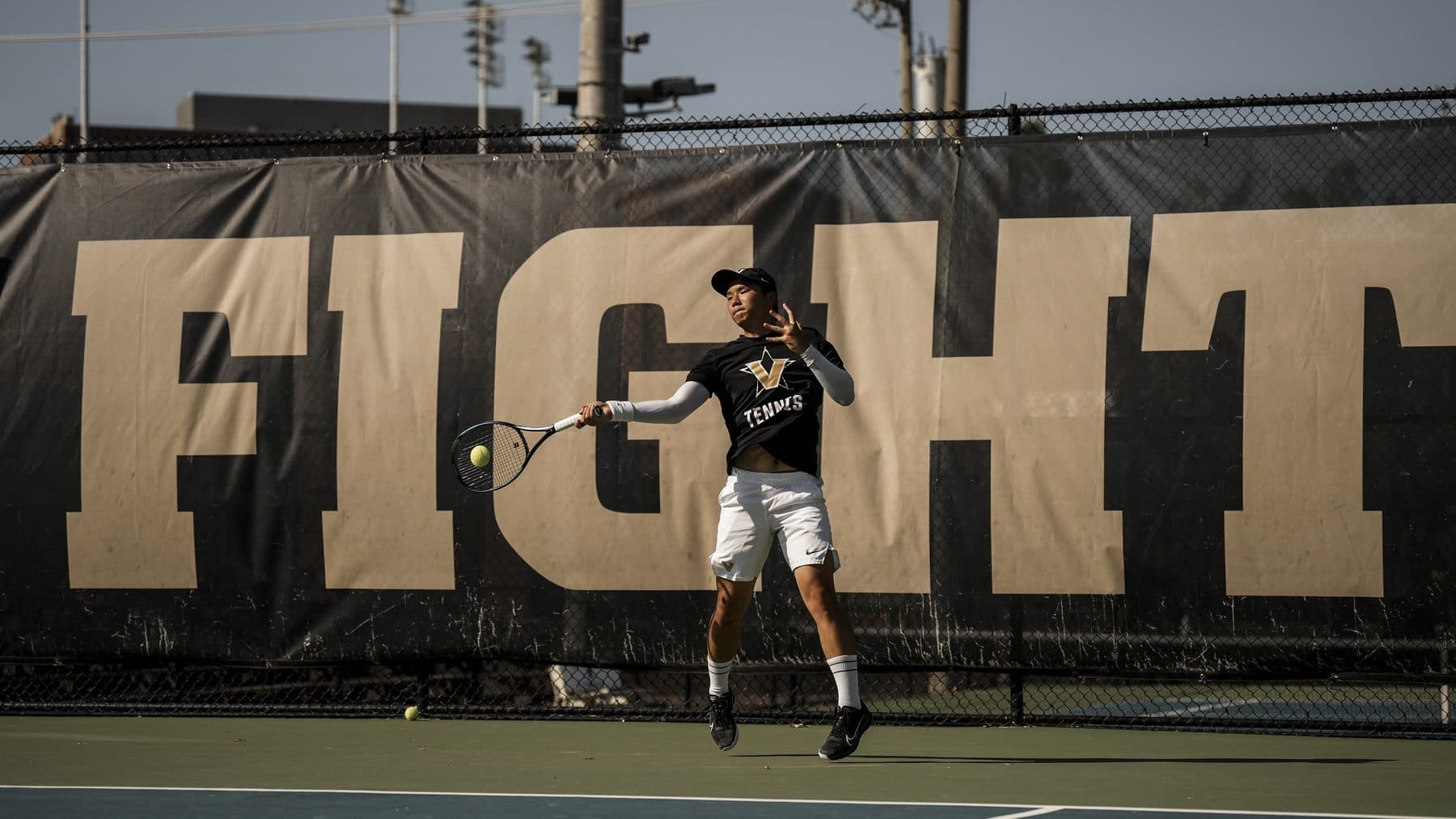
Paul hitting a forehand on the Vanderbilt courts
Vanderbilt University · NCAA Division I

"I contacted around 20 schools. I wrote and sent every cold email myself, and not many came back. So I understand how players feel now. It is not that they are not trying. It is that they often cannot tell whether they are doing it right, and they do not know what the next move is."

Paul Wang, founder of Kuroshio Athletics. Vanderbilt University Men's Tennis, NCAA Division I

Paul came up through Taiwan's sports-class system. Watching the seniors around him, the future seemed to hold two roads: turn professional, or become a coach. Both are good roads, but he started to wonder. After all these years of tennis, could there be more choices than that?

Then in high school he got into the World Scholar's Cup, Model UN and robotics competitions, and realised something for the first time: the world is large, and tennis can be a road into it rather than the destination.

There were no UTR Verified events in Taiwan then, so he and his family flew to the US to compete two summers running, more than NT$800,000 all in. At one of those events a Vanderbilt coach saw him. He was around UTR 12, and he ended up negotiating a 40% scholarship. Only years later, looking back, did he understand: a great deal of it could have been prepared better, and negotiated better.

He had finished runner-up at Taiwan's National High School Games. At Vanderbilt he started again at No. 6 singles and No. 2 doubles. Once he was in college he slowly discovered that what actually needed preparing went far beyond tennis. A junior-year placement in a public high school required courses that had to be lined up in freshman and sophomore year. The university also had scholarships, exchanges, clubs and all kinds of resources, and many of those chances he only found out about later.

A stress fracture in his elbow in sophomore year, a coaching change in junior year. In the end he left the team, gave his final year of college to himself, and started asking a different question:

"If somebody had told me these things earlier, would it have turned out differently?"

That is why he wanted to build Kuroshio. He does not want a college-placement service to end the moment a player is put into a school and hands back an offer. Because what matters is not only which school you can get into.

What we want is that on the day a player finishes with Kuroshio, they leave with more than an offer. They leave knowing who they are better than they did when they started, and knowing where they can go next. That is harder than getting an offer, and it matters more.

  • What do you want?
  • What are you capable of?
  • How far are you from the goal?
  • Who do you want to become?

Why us

We run the UTR events ourselves

UTR is one of the key evaluation tools in US college tennis recruiting. Most consultants can only read the number. We run UTR Verified events that are well known across Asia.

about90%

of Taiwanese players earn their rating at events run by this team, and use it to apply for US college scholarships

NT$1.2M

the average scholarship those players received per year, up to about NT$5M across four years

NT$4.8M

in prize money secured for our events each year

Pincheng is one of the host teams on the UTR Pro Tennis Tour 2026 global calendar, and works with partners in Korea, Japan, India and the US, including chair-umpire and federation links.

The event, scholarship and prize-money figures above come from Pincheng's own operating records. They are results that have already happened, not a promise to any individual player. Kuroshio is a Pincheng service, so players have access to these event resources, but results on court and in recruiting still come down to the player.

Edge 01

Not "play more tournaments". Deciding together what the next one should be.

Years of running events have brought players from several countries to Taiwan to compete. Being on the tour calendar ourselves lets us go a step further, working from the player's current UTR and recruiting targets rather than from whatever happens to be on next month.

  • Schedule the right Verified events instead of playing whatever is available
  • Build a match record that actually holds the rating up
  • Full match footage that becomes recruiting film directly
  • Review it together afterwards: what was this match worth for recruiting?
Edge 02

Not just teaching players to send letters. Helping them present themselves well.

When a coach meets a player for the first time, UTR is not all the coach looks at. Match film, the player's information and how the player comes across all feed into whether the coach keeps reading. UTR's own College Showcase bundles Verified matches, player profiles and coach viewing together for the same reason. So we keep our own film and design team.

  • Film: a professional editor works through the footage with the player, and the consultant weighs in on which point stays, what coaches want to see, and how to make the player's strengths land faster
  • Design: a designer builds the player assets recruiting needs, so the player's information reads clearly in outreach, on social and in self-introductions

We do not package a player into someone else. We just make the real person easier for a coach to see.

One formula for everyone. No case-by-case negotiation.

Two tracks, each independent.You can buy just one.

An agency works the application season. What we do is multi-year preparation and recruiting itself, sold as two separate things, so you buy the part the player actually needs. We go through the full cost in the consultation, from one formula that applies to everyone.

First, meet us

Consultation

NT$1,500

Two short questionnaires, one for the parent and one for the player, then a 60-minute call online. We do the research before the call, so we spend the hour on the roads open to the player right now. No pitch. You decide whether to take the next step.

Then, judge

Assessment

NT$7,500

A full questionnaire, a 90-minute in-depth interview, a written report in two versions, and 60 minutes going through it. We tell you where the player stands, what is missing, how much time is left and which road to take. If it is not the time to start, we say so plainly.

Then, begin

The service

Two tracks. They stack.

Foundation is a one-year small-group program built around a personal project; it trains what a player needs to stand on their own once they are there. The Recruiting Project is recruiting itself: coach outreach, choosing schools and applying. Two tracks, independent, either one on its own. You do not have to guess which to buy. The assessment report tells you where to start.

Whatever you have paid is credited forward. The NT$1,500 consultation credits against the assessment, and the NT$7,500 assessment credits against the service. Go the whole way and neither costs you anything extra.

Gets the player in

Recruiting Project

A single fee

From signing to the end of freshman year. The closer you sign to the November signing period of Grade 12, the higher the price, up to a cap. The first cohort pays a founding price.

  • What an agency does: Application documents, filing and follow-up; everything an agency does for you is in here
  • The player's own accounts: We set up the player's own Gmail, Drive and Calendar, and everything afterwards goes out from there
  • Letters and introductions: Essays, coach letters, self-introductions: we could write them, but the player has to learn to. We edit, and it sends from the player's own account
  • Schools and coaches: A three-tier school list, coach outreach and follow-up, and preparation for coach video calls
  • Match film: Filming and editing, drawing on Pincheng's UTR-sanctioned events
  • Offers and scholarships: Certified-translation QA, net-value offer comparison and scholarship negotiation
  • Paperwork before departure: Conscription, NCAA final certification, the I-20 and visa, and departure prep
  • Freshman year: A full year of support, included and not sold separately

Entering in the spring of Grade 11 or in Grade 12 means the assessment comes first. The later it gets, the less likely we are to take a case on sight. We evaluate UTR, academics, English, NCAA eligibility and the time remaining, and only start if it is viable. The contract sets out the feasibility assessment, the standard for taking a case, the scope of work and the process guarantees. We do not guarantee admission, but we are accountable for every case we choose to take.

Keeps the player standing

Foundation

A subscription

A one-year small-group program built around a personal project. Mainly Grade 10 and 11, billed once per semester.

  • Personal project: One project a year, proposed and carried out by the student, and presented by the student at the annual showcase
  • Topic guidance: A four-week topic process after joining: an aptitude questionnaire, guided activities and one-to-one consultation to find a topic that is their own
  • Biweekly studio: At most 8 per cohort. Progress reports, peer questions, individual guidance and extra material
  • Monthly one-to-one: 30 minutes, only about the student's project and how their learning is going
  • Skills courses, on demand: Project management, time management, interviewing and presenting, college prep. Online, available any time, used when the student actually needs them
  • Learning log: Weekly goals and outcomes, reviewed together every month
  • English one-to-one: Lessons can be added as needed

Foundation and the Recruiting Project are independent; you can choose just one. The Recruiting Project handles getting into a US college. Foundation handles whether the player can stand on their own once they are there.

I spent four years at a US college. What I saw most was not players who could not keep up on court. It was first-year academics, time and asking for help, three things that did not keep up. These abilities cannot be patched in the three months before departure; they take two years of practice. We do not practise them through classes. Each student completes a piece of work that is their own, and the abilities that need building grow out of that process.

The first cohort starts in January 2027 with limited places, led by Paul in person. There are no past results to show yet. What we can show is the complete process design and how the guidance works.

Both matter equally. The Recruiting Project decides how many opportunities are on the table. Foundation decides how good those opportunities are. The key NCAA D1 recruiting date is June 15 after sophomore year. But how many coaches are willing to look at the player seriously on that day depends on the UTR, academics, English, matches and preparation built up over the years before it. Opportunity is not created on June 15. By then it has been accumulating for two years.

Why signing early costs less

The Recruiting Project price moves with the clock

Coaches can sign a player from November 15 of Grade 12. Everything we do has to be finished before that day: the school list, the letters, the film, the eligibility file. Sign with fifteen months or more to go and you pay the base price. Come later and the same work has to be compressed into less time. The price reflects that compression.

Count back from November 15 of Grade 12. Fifteen months or more out is the base price. Every three months closer moves the price up one step, and the surcharge is capped, so it does not climb without limit. The spring of Grade 12 is the latest anyone can sign. We go through the actual figures in the consultation, together with the founding price for the first cohort.

The Recruiting Project price moves with the clock
When you signMonths to Nov 15, Grade 12How we see it
Before Aug 15, the summer before Grade 1115 or moreBase price. The best time to start
Sep to Nov, Grade 1112 to 15Still enough time
Dec to Feb, Grade 119 to 12Starting to compress
Mar to May, Grade 116 to 9Assessment first
Jun to Aug, the summer before Grade 123 to 6Assessment first; we may decline
Sep, Grade 12 onwardunder 3, cappedThe latest possible start; we may decline

How many we can take, and refunds

There is a hard limit on how many players we can carry at once. That is not a marketing line, it is arithmetic: a player on both tracks needs two one-to-ones a month, one for recruiting and one for foundation, and they are not merged.

The Recruiting Project's six phases follow the six stages of Taiwan's Ministry of Education standard study-abroad contract: school selection 15%, documents 15%, submission 25%, admission 20%, visa 15%, departure and first year 10%, with refunds on the statutory ladder. We add two refund triggers of our own: every school on the list carries an individual reason, and if a boilerplate list is found we refund that phase in full; if no coach replies in writing within 90 days of submission, we refund half the submission phase.

Recruiting English, as an add-on

One-to-one and custom built. No off-the-shelf course. We start from the English threshold at the target schools, assess how far the player is from it, and decide from there what to teach and for how long. Requirements genuinely do differ between US universities.

Academic English: essays, college writing and classroom English. Recruiting English: self-introduction, tennis English, coach interviews. Test English: TOEFL, IELTS, Duolingo and others, aimed at the target schools.

Billed in blocks of 10 lessons. The point is not to finish teaching English. It is to fill in the English the application and the move to the US actually require.

How to start

A 60-minute consultation first.Then decide about the assessment.

Consultation NT$1,500, assessment NT$7,500. The consultation credits against the assessment, and if you later join the service the assessment fee is credited against your plan. If the assessment says now is not the time to start, we say so plainly. The report still includes an action version you can run without us, so you know what the next step is either way. If it does not fit, you still do not leave empty-handed.

  1. Consultation60 min online

    NT$1,500

    Two short questionnaires, one for the parent and one for the player. Once both are in we reply to schedule. We do the research before the call, and the hour covers three things: where the player stands now, the roads open to them right now, and how the whole service runs. No pitch. We stop when the conversation stops, and you decide whether to take the next step.

    What happens next

    The same day you receive a two-page summary of the roads we discussed and what to do in the next three months. If you then reply that you want the assessment, we send the assessment questionnaires, payment details and the next steps. Payment received and questionnaires in, the in-depth evaluation begins.

  2. Fill in the questionnaire7 days before the interview

    This is where the assessment starts

    One questionnaire for the parent and one for the player. The parent version carries subject-by-subject transcripts for every semester from Grade 9 and one full match on video; the player version asks the player about themselves. NCAA eligibility review for international students already covers academic records from year nine, so we review from Grade 9 onward in full. No match film is fine: the questionnaire includes filming instructions, and a phone on a fixed mount recording one full match is enough.

    What happens next

    We only schedule the interview once all of it is in. That is not to create work. It is so those 90 minutes go into analysis and judgement instead of chasing basic information.

  3. Report preparation2 days before the interview

    Nothing for you to do

    Once we have your material we complete the NCAA eligibility estimate, the UTR positioning, an initial direction of six to nine schools, a full analysis of the match film, and the list of questions for the interview. NCAA eligibility itself requires line-by-line confirmation of core courses, grades and academic records, so it has to be reviewed in full first.

    What happens next

    This preparation takes about four hours and you are not part of it. Because we do the homework first, the 90 minutes that follow can actually be spent helping your child.

  4. Assessment interview90 min online

    Player and parents both attend

    We watch that full match together, ten minutes in English, time with the player alone, time with the parents alone, and a short quiz on the rules. Splitting it is deliberate. Some honest answers only appear when the parents are out of the room.

    What happens next

    Writing starts the moment the interview ends, and it reaches your inbox within 48 hours.

  5. Report deliveredwithin 48 hrs of the interview

    One parent version, one player version

    The report contains nine areas of analysis plus two feasibility verdicts. The player version leads with strengths and turns weaknesses into drills the player can actually do next. Time feasibility compares four routes side by side to see which still works. Budget feasibility works from the financial capacity each school requires for the I-20 and the estimated costs, converted into a four-year NT$ range. Schools generally require international students to show proof of funds for at least the first academic year before issuing an I-20, and their estimates vary widely.

    What happens next

    After the report goes out we schedule a 60-minute debrief to read it through together and confirm the next step. We do not send a PDF and call the service finished.

  6. Report debrief60 min online

    The assessment ends here

    A 60-minute debrief where we confirm the three most important things for the next three months, which stage you would start at, and whether now is the right time to start at all. If we judge that it is not, we say so directly and give you an action version you can execute without us.

    And then

    Whether to join is something you decide at home. We do not ask on the call and we do not chase a signature. The report is there to help you decide, not to push you into deciding.

FAQ

Frequently asked questions

How are you different from a study-abroad agency?

Agencies do certain things and so do we: application documents, translation QA, the NCAA Eligibility Center, the visa and preparation for going to the US.

But we start earlier and stay longer: long-term preparation from Grade 8, data-based positioning on school choice, student-athlete development, and support through the first year in the States.

And one difference that matters most: we are perfectly able to do these things, but what we want is for the player to become able to. The letters to coaches, the interviews, the self-introduction and the final decision are the player's. We teach, we sit alongside, we edit, but we do not ghostwrite. Because what we are preparing is not just an application. It is a person who, once in the US, can write to a professor, talk to a coach and decide for themselves.

What UTR does my child need to have a chance?

The honest positioning first. Men at UTR 10.5 to 12 can be evaluated for parts of D1, for D2, NAIA and competitive D3. Women at UTR 8 to 10 can start being evaluated across parts of D1, D2 and other levels.

But these are not thresholds. They are simply where you are now. The assessment reads the Verified UTR, the transcripts, a full match on film and the UTR growth curve together, to judge where the player can go now and where they are likely to go next.

No Verified UTR yet? That is fine. The assessment deals with that step first.

When is the best time to start?

The spring of Grade 8 through Grade 10 is the best window, because US college tennis recruiting starts earlier than most parents expect. Under general NCAA D1 rules, coaches can begin phone and electronic contact from June 15 at the end of sophomore year, and NCAA core courses start accumulating from the beginning of high school.

So before that day arrives, the UTR, match film, resume, school list and academic eligibility all have to be built up step by step. From the spring of Grade 8 through Grade 10 there is still time to lay the foundation properly. After Grade 10 the preparation window shortens sharply: do the assessment first, and only enter the Recruiting Project if it is viable.

Starting earlier is not applying earlier. It is being ready when the opportunity arrives.

What does it cost in total?

The two tracks are priced separately and you can buy just one. The Recruiting Project is a single fee covering everything from signing to the end of freshman year. Foundation is a subscription, one cohort a year, billed by semester.

What the Recruiting Project costs depends on when you sign. The earlier it is, the lower it is, and the surcharge for signing late is capped. We go through the full figures, the formula and the founding price for the first cohort in the consultation, and the formula is the same for everyone: no case-by-case negotiation. The consultation and assessment fees credit forward, so going the whole way means the first two steps cost you nothing extra.

US tuition and living costs are separate. Actual costs vary enormously by school, region and scholarship, and when a school issues an I-20 it requires proof of funds matched to its own tuition and living estimates. The assessment report factors this in, producing three budget scenarios across four years as NT$ ranges. Not just where the player can go, but whether you can afford to get there.

Do you guarantee admission?

No. Admission and recruiting outcomes are not something any consultant decides unilaterally, and we will not use a guarantee of admission to get you to sign.

What we do stand behind is the process. The contract turns what we are supposed to deliver into verifiable commitments, and if we fail to deliver, we refund under those terms. Every school on the list must carry an individual reason for being there; if a boilerplate list is used, that phase is refunded in full. On coach outreach, if no coach replies in writing within 90 days of formal submission, we refund 50% of the submission-phase fee.

We do not guarantee that any particular school will want your child. We are accountable for every step that is ours.

What if the assessment says it is not a fit?

We say so directly, and we tell you why. The report includes an action version you can run without us, setting out the three most important things for the next three months. The report is yours to keep in full.

The assessment fee is not refunded. But if conditions change and you want to restart within a year, that fee credits toward the service. If it does not fit, we do not force it. You still leave knowing what the next step is.

How good does the player's English need to be? Is TOEFL required?

TOEFL, IELTS and Duolingo are the school's admission requirement, not a blanket NCAA rule. Whether to sit a test and what score to aim at comes from the threshold at the player's target schools plus where the player is now, and that decides what we teach and for how long.

But two things matter to us more: following a lecture and writing the assignment, and answering on their own on a Zoom call with a coach. Those are not for a test. They are what the player uses every day in the US.

The Recruiting Project includes simulations before coach Zooms. If more is needed you can add one-to-one Recruiting English; Foundation's English one-to-one is likewise added as needed. We do not teach a fixed curriculum. We fill in the English the player is actually missing.

What about conscription for boys?

Conscription and the NCAA run on two different clocks. Taiwan's conscription age counts from January 1 of the year he turns 19. The current NCAA D1 rules read his 19th birthday against September 1 to determine the eligibility timeline.

At the assessment we run both timelines separately from his date of birth, to confirm early whether studying in the US conflicts with NCAA eligibility. In February of Grade 12 we confirm conscription status and the overseas-study exit process; before departure we confirm the enrolment documents, exit permission and related procedures. Male citizens who meet the requirements can apply to leave under the overseas-study process.

Conscription is not something handled at the end. It goes into the timeline from the very start.

What do parents do?

Parents matter enormously, but not as the person who completes recruiting for the player.

During the preparation stage there are two parent workshops a year, and parents join the monthly reports and quarterly reviews. During recruiting, parents stay across the progress, but the player talks to the coaches, does the interviews and makes the decisions.

The assessment report has a separate parent version, and the ninth axis, support system, analyses how the family's way of communicating and supporting affects the player. We want parents present the whole way, while gradually handing the leading role to their child.

What happens once the player is in the US?

Admission is not the finish line. The real test starts on arrival, which is why our recruiting and landing plan runs all the way to the end of freshman year.

A 30-minute video check-in every month. One three-way review each semester with the student, the parents and the consultant. Day-to-day questions handled by message. A full annual review at the end of freshman year.

From coursework to the team, from talking to the coach to adjusting to life there, we help the player get their footing in that first year. The contract also states clearly what we help with in year one, and which things the player has to do on their own.

Step one

Spend an hour getting to know us

Consultation NT$1,500. The parent and the player each fill in a short questionnaire, we do the research, and in a 60-minute call online we lay out where the player stands and the roads open to them. If you continue, whatever you have paid credits forward.

  1. Consultation NT$1,500, two short questionnaires plus 60 minutes online
  2. Assessment NT$7,500, the consultation fee credited, long questionnaires plus a 90-minute interview
  3. Report within 48 hours, in a parent version and a player version
  4. 60 minutes reading it together, then you decide whether to start
  5. Join the service and the assessment fee is credited

Kuroshio enquiry forms

NT$1,500, 60 minutes

Book a 60-minute consultation

Two short forms, no files to attach: one for the parent, one for the player. Once both are in, we reply within two working days with payment details and a booking link. If you go on to the assessment, those questionnaires are sent to you separately.

For the parent

Parent version, about 8 minutes

For the player

Player version, about 10 minutes. Fill it in yourself.

Both forms open in a new tab.

Questions first? Email us support@pinchengcaptain.com

A Pincheng Marketing Co., Ltd. service

The fees and process described on this page are a general explanation. The signed written contract governs. We do not provide any guarantee of admission or scholarship.